The Subaru Outback has spent decades carving out its own lane — part wagon, part SUV, all practicality. For 2026, Subaru gave the Outback its biggest overhaul in years, pushing it further into midsize SUV territory. The question for families cross-shopping this segment is simple: does the redesign make the Outback a smarter buy, or does it lose the charm that built its loyal following?
Pricing and Trims
The 2026 Outback comes in six trims, starting with the Premium at roughly $34,995 to $36,445 depending on the source and configuration, and topping out with the Touring XT around $47,995 to $49,405. That’s a wide spread, but even at the top end, the Outback undercuts several of its closest rivals — reportedly landing anywhere from $3,300 to $9,700 less than comparable trims from Honda, Toyota, Volkswagen, and Jeep.
For most families, the sweet spot in the lineup sits around the Limited trim, which adds a nicer interior and extra convenience features without pushing into the pricier turbocharged models. Families who tow trailers, haul bikes, or need extra confidence in bad weather may want to look at the Limited XT or Wilderness trims instead, both of which come with the more powerful turbocharged engine.
Powertrain: Adequate, Not Exciting
Under the hood, the Outback offers two engine choices. The base setup is a 2.5-liter flat-four making 180 horsepower and 178 lb-ft of torque, paired with a CVT and standard all-wheel drive. Step up to an XT or Wilderness trim, and you get a 2.4-liter turbocharged flat-four producing 260 horsepower and 277 lb-ft of torque.
The base engine is fine for daily commuting and errands but can feel strained when fully loaded with passengers and cargo, especially on highway merges or mountain grades. The turbo engine solves that problem and adds real confidence for road trips, but it comes with a fuel economy trade-off — expect city mileage in the low 20s with the turbo versus the high 20s to low 30s with the standard engine.
Towing capacity tops out around 3,500 pounds when properly equipped, enough for a small camper, a boat, or a utility trailer, though not in the same league as a body-on-frame SUV.
Space and Everyday Practicality
This is where the Outback earns its family reputation. Cargo space behind the second row comes in at 34.6 cubic feet, expanding to 80.5 cubic feet with the seats folded — enough for strollers, sports gear, camping equipment, or a full warehouse-store run. A power liftgate and a low load floor make loading easier, which matters more than it sounds like once you’re wrangling kids and groceries at the same time.
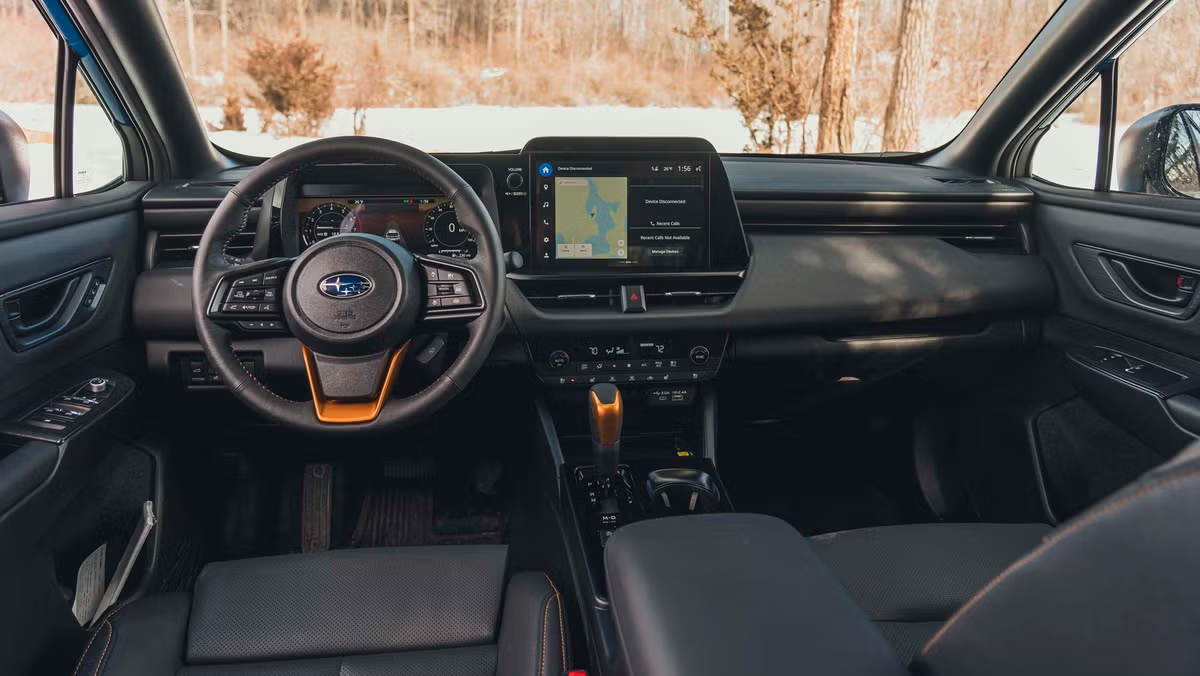
Headroom has actually improved with the redesign, which benefits taller parents and growing kids in the back seat. The cabin also picked up nicer materials across most trims, along with a reworked 12.1-inch touchscreen that comes standard across the lineup, with wireless Apple CarPlay and Android Auto built in.
Safety: Still One of the Outback’s Strongest Selling Points
Subaru has built its family-friendly reputation largely on safety, and the 2026 Outback keeps that streak alive. It has been named an IIHS Top Safety Pick+, one of the highest honors a vehicle can earn in crash testing and crash-avoidance evaluation.
Every trim comes standard with Subaru’s EyeSight suite, bundling adaptive cruise control, automatic emergency braking, lane centering, and acceleration override assist. Blind-spot monitoring and lane-keep assist are also standard across the board — not locked behind a top trim, which matters for families shopping on a budget. Touring trims add a newer feature for 2026: hands-free highway driving at speeds up to 85 mph, plus a 360-degree Surround View Monitor for tighter parking situations.
Standard all-wheel drive rounds out the safety picture in a less obvious way — for families driving through snow, rain, or rough weather regularly, that added traction is a real, everyday safety benefit rather than just an off-road feature.
Reliability and Ownership Experience
Owner-reported reliability data for the redesigned Outback has been strong so far, with consumer ratings sitting around 4.9 out of 5 and a large majority of owners saying they’d recommend the vehicle to others. Subaru as a brand has also consistently ranked near the top of independent reliability studies in recent years, which adds some reassurance for a redesigned model in its first year on the road — typically the riskiest time to buy any new generation.
Where the Outback Falls Short
Not every change has been universally praised. The shift toward chunkier, more SUV-like styling has divided longtime Outback owners — some appreciate the tougher, more rugged look, while others feel it sacrifices the distinctive wagon identity that set the Outback apart from every other crossover on the road. It’s a styling debate rather than a functional flaw, but it’s worth test-driving in person before deciding how you feel about the new look.
The base engine’s power delivery is another minor caveat. It’s adequate for most commuting and family duty, but families who frequently drive with a full cabin, cargo, or a trailer in tow may find themselves wishing they’d sprung for the turbo engine from the start.
Bottom Line for Families
The 2026 Subaru Outback checks nearly every box that matters to family buyers: strong standard safety tech, real cargo flexibility, standard all-wheel drive, a comfortable and now more spacious cabin, and pricing that stays competitive against rivals from Honda, Toyota, and Jeep. It isn’t the most powerful or the flashiest vehicle in its class, but it’s built around the kind of dependable, adaptable practicality that family life actually demands — snow days, road trips, sports gear, and all.