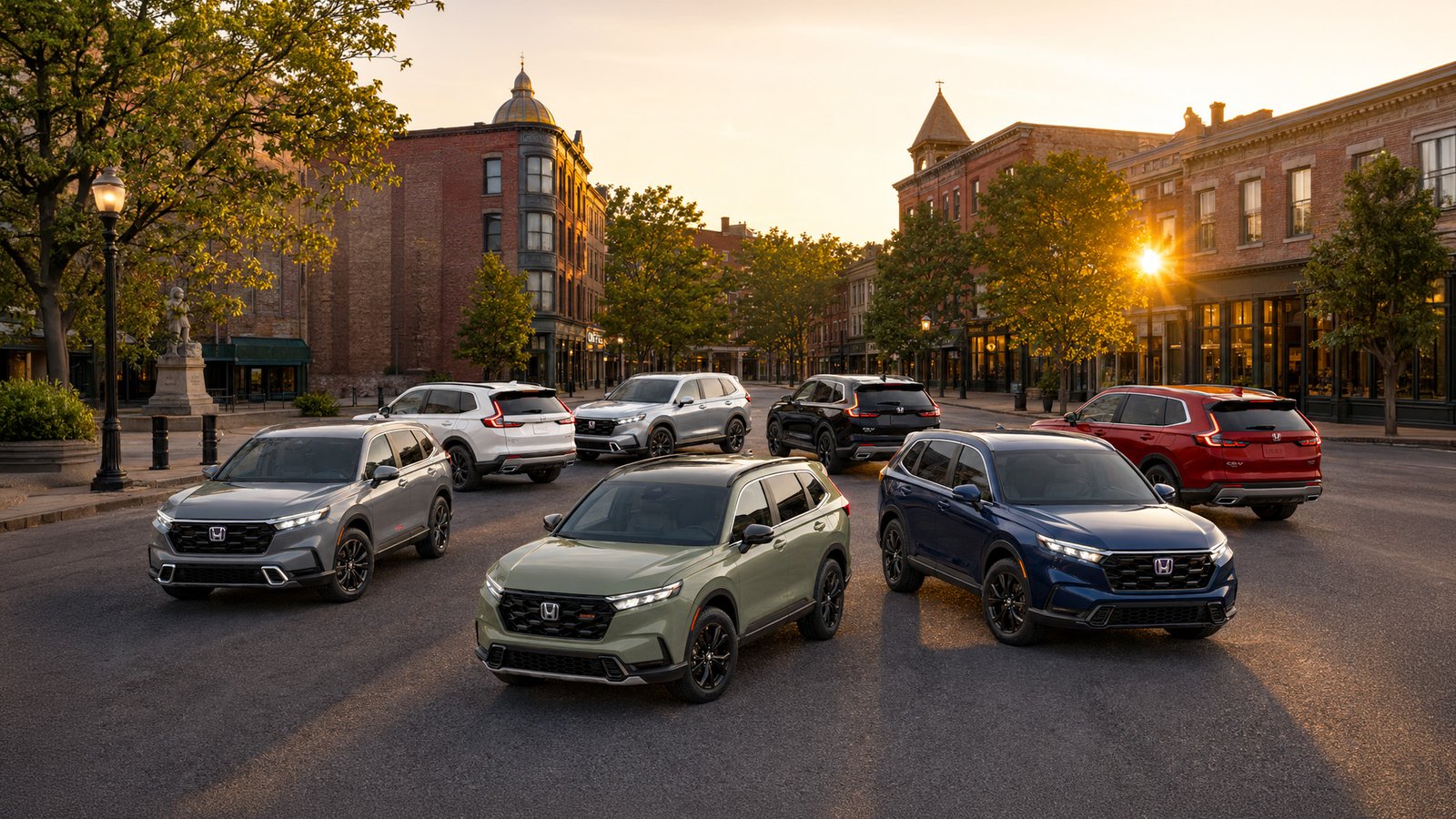
The Honda CR-V doesn’t chase headlines the way some rivals do. It doesn’t have the flashiest styling or the biggest horsepower number in its class. And yet, year after year, it remains one of the best-selling vehicles in the entire United States — not just in the compact SUV segment, but across nearly every category. For 2026, Honda hasn’t reinvented the CR-V; instead, it’s sharpened almost everything that already made it a benchmark. Here’s a full breakdown of why it keeps winning
Pricing and Trim Lineup
The 2026 CR-V is offered in seven trims, four of them hybrid-powered. Pricing starts at roughly $30,920 to $32,370 for the base gas model, climbing to around $42,250 for a fully loaded Sport Touring Hybrid. The hybrid range on its own starts around $35,630 to $37,080, depending on trim and source.
That spread gives buyers a genuinely wide entry point: cost-conscious shoppers can stick with the turbocharged 1.5-liter gas engine, while efficiency-focused buyers can move straight into a hybrid without needing to jump to the most expensive trims. The EX-L trim tends to sit at the center of the lineup and is frequently cited as the strongest overall value, balancing features and price better than the trims above or below it.
Three Powertrains, One Clear Standout
Honda offers three distinct powertrain paths on the CR-V: a turbocharged 1.5-liter four-cylinder for buyers prioritizing upfront cost, a 2.0-liter hybrid system for buyers prioritizing efficiency, and a unique e:FCEV hydrogen plug-in hybrid variant for a small niche of buyers in markets with hydrogen infrastructure.
The gas-only CR-V returns around 30 mpg combined, which is respectable but unremarkable for the segment. The hybrid is where the CR-V earns its reputation. Hybrid AWD trims are rated around 37 mpg combined, and front-wheel-drive hybrid trims stretch that to about 40 mpg — some sources list a range as wide as 34 to 43 mpg city/highway depending on trim and equipment. The hybrid also produces 204 horsepower, giving it a genuine power advantage over the standard gas engine in addition to the efficiency gain.
For 2026, the hybrid lineup also picked up a newly revised all-wheel-drive system built for better traction, along with hill-descent control now included on the new TrailSport trim — a more rugged-looking version of the CR-V Hybrid introduced this year specifically to compete with off-road-styled rivals.
Space, Comfort, and Everyday Usability
Interior space remains one of the CR-V’s strongest selling points. Hybrid models offer 36.3 cubic feet of cargo space behind the second row, while non-hybrid versions offer slightly more at 39.3 cubic feet, since they don’t need to package a battery. Folding the rear seats expands cargo room to 76.5 cubic feet in either configuration — plenty for family hauling, weekend trips, or big-box shopping runs.
Ground clearance sits at 7.8 inches on standard models and 8.2 inches on AWD trims, enough for light snow and light off-road use without turning the CR-V into a true off-roader. The cabin itself has been praised for a clean, minimalist design with an upscale feel in higher trims like Sport-L and Touring, featuring soft-touch materials and a horizontal mesh-accented dashboard. Ride comfort has also improved generation over generation, with reviewers noting composed, secure handling and steering that feels more precise and athletic than most buyers expect from a vehicle in this class.
Technology Updates for 2026
The 2026 model year brought a round of tech-focused updates rather than a full redesign. Every CR-V Hybrid now comes standard with at least a 9-inch touchscreen, along with wireless Apple CarPlay, wireless Android Auto, and a wireless phone charger built in as standard equipment across the hybrid lineup. Higher trims add a larger display and additional convenience features.
One recurring complaint in owner and reviewer feedback is Bluetooth and phone-pairing reliability, which has been flagged as inconsistent when switching between multiple paired devices — a minor but persistent annoyance rather than a dealbreaker.
Reliability and Resale Value
This is arguably the CR-V’s biggest long-term selling point. Honda has built a reputation over literal decades for reliability and strong resale value in this nameplate specifically, and the CR-V continues to rank as a top pick among independent reviewers for exactly that reason. That reputation matters more than raw spec numbers for a lot of shoppers, since a compact SUV that holds its value well and rarely needs unplanned repairs ends up cheaper to own over time, even if the sticker price isn’t the lowest in its class.
Why It Keeps Winning Sales Charts
None of the individual numbers here — mpg, horsepower, cargo space — represent a class-leading extreme on their own. That’s actually the point. The CR-V wins by being extremely good across nearly every category buyers actually care about, rather than exceptional in just one. It’s roomy without being oversized, efficient without requiring a plug-in commitment, comfortable without sacrificing composed handling, and reliable enough that resale value stays strong years down the line.
Add in a wide trim spread that lets nearly any budget find an entry point, a hybrid option that no longer feels like a compromise, and updated tech that finally closes the gap with newer rivals, and it becomes easier to understand why the CR-V keeps topping sales charts. It isn’t the SUV that wins any single spec sheet category outright — it’s the one that rarely gives buyers a reason to look anywhere else.